
For over one month, the Holy Land has been living the most difficult and dangerous period in our lifetime. A daily life that is interrupted several times by the sounds of multiple sirens directing us to shelters, followed by the sounds of missiles, interceptors, and fighter jets flying so close overhead, and then explosions, some in a distance, while others so close that the building shakes. Then speculation starts with a rush to social media and TV screens to learn more about the impact, amount of damage, and more importantly the safety of loved ones. The most frequent question on all our minds is where this war is going and what the end result will be. Judging by our recent example of Gaza, one worries that when all is said and done, many areas in the Middle East will look like Gaza. Humanity (if that word still exists in the dictionary) thought that the level of destruction and human loss in Gaza should have been something that the whole world was ashamed it happened on its watch, not an example to be proudly applied elsewhere! It is certainly a crocked world, and we all have a lot of work ahead of us, war or not, to bring this world back to humanity.
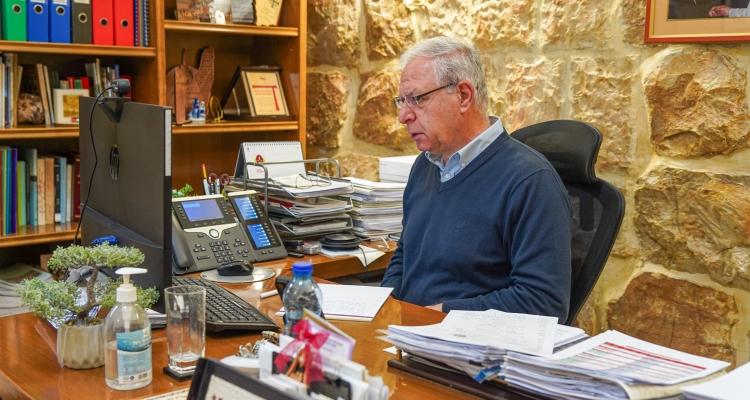
Since the first day of the war, it was very clear that this would be an extended and difficult war. One that will present huge challenges around the world. With our long experience in wars, intifadas, crises, and the whole spectrum in between, sadly we gained experience of what we need to do as church workers. The tough life we live in the Holy Land taught us that Holy Week is every week and we must rise to the occasion every week. Our staff were heroic in returning to full capacity within a week after the start of the war. They fully realized that if they are not at their desk and not simply be content with working remotely from home, hundreds if not thousands of people who rely on the pastoral, educational, and humanitarian support of the Latin Patriarchate will be deprived of receiving basic services. The courage and sense of giving we have witnessed is truly admirable. For many young parents, that meant leaving children behind following online classes, taking risks traveling to work when sirens may go off, and dealing with the trauma of being at work and getting interrupted multiple times per day during the workday with sirens and explosions. For me this is not only a reflection of the dedication and commitment of our staff, but a true sense of their realization of what it means to be a church worker during time of crisis. A time to think and care about others before looking inwards. Thus, we are very proud to say that the work continued uninterrupted during challenging times.
The Old City, due to its historic nature and architectural complexity, does not have the luxury of more modern quarters in Jerusalem and lacks public shelters. Thus, it has received more harsh treatment from the home front command than any other location. The commercial activity came to a complete stop with all shops closed since the beginning of the war excluding food shops and pharmacies. The Holy sites for all three religions were shut down tightly including the Church of the Holy Sepulchre; the Al-Aqsa Mosque; and the Wailing Wall plaza. Sadly, all this happened during significant religious seasons for all being the end of the holy month of Ramadan; Passover; and Easter.
The faithful had no place to go for their prayers and time of reflection. Tensions escalated amidst the frustration and incidents took place including low level police officers prohibiting His Beatitude Cardinal Pizzaballa and the Custos of the Holy Land Fr. Francesco Lelpo from making their way to the Church of the Holy Sepulchre on Palm Sunday. That incident snowballed with the pouring of support from around the world including some very high-ranking officials. This was quickly contained by the higher-up authorities and agreement was reached on how to proceed with liturgical celebrations during Holy Week respecting at the same time the emergency instructions of the home front command. If that incident shows anything, it is that we are not alone and the world cares about us and about our affairs and about preserving the holy places so that they continue to be beacons of hope. Places where the whole world looks up to and direct their prayers in ordinary and extraordinary times. It was a quick lesson about history, significance, respect, and coordination and communication. It was another lesson on the importance for all to understand the importance of Jerusalem to all faiths and the need to respect tradition and the respective space for each religion, and a stark reminder that Jerusalem must be an open shared city for all to enjoy. No exclusive rights for any religion will be tolerated by the faithful of all religions around the world.
Holy Week in Jerusalem will be very sad without the tens of thousands of pilgrims making their way through the narrow alleyways of the Old City speaking tens of languages and chanting their prayers along the way. However, we should never forget the true meaning of the season for all monolithic religions. Ramadan, Passover, and Easter are a time when one is drawn back to the true meaning of the season. Each in their respective faith tradition prays from peace and the common good, make sacrifices towards those less advantaged than us, and act to make this world a better place. During the season, we look for new life and a new beginning. As harsh the events of Holy Week are in the life of our savior, Easter represents an end and a new beginning that is characterized by hope. Despite the harshness of the war conditions that we live in and the uncertainty we face, Easter bring a sense of hope that there is still some goodness in this world.
Happy Easter to all our friends and supporters around the world. With your moral and financial support as well as your continued prayers, you give us hope and encourage us to keep walking in the footsteps of our Lord. We will not disappoint you!